
BY SANJEEB KUMAR SAHOO
Before I start what I promised at 8:37 p.m. on September 26, I would first like to say that winter has almost arrived in Delhi, as the weather started changing on the night of September 25. I could feel the winter chill despite the intense political heat in the national capital following The Indian Express newspaper’s reports on Chief Election Commissioner of India (CEC) Gyanesh Kumar’s alleged “one-man rule” and unilateral decision-making, while reportedly ignoring the suggestions of Election Commissioners (ECs) Sukhbir Singh Sandhu and Vivek Joshi.
Well, why should I start dancing just because everyone else is dancing after The Indian Express reported it? A report by The Indian Express is certainly worth reading, but facts deserve scrutiny. Therefore, I prefer to examine the facts and make my own judgement.
I am expressing my views only after giving the matter considerable thought, because I understand how news, information, and agendas can sometimes reach selected media houses, female journalists, and male journalists from lawmakers and political executives.
Interestingly, the late Ramnath Goenka became the owner of The Indian Express in 1932 after acquiring complete control of the newspaper from P. Varadarajulu Naidu, who had founded The Indian Express in Madras (now Chennai).
However, Ramnath Goenka was not only a newspaper publisher but also entered electoral politics. He contested an election on a Bharatiya Jana Sangh (BJS) ticket and served in Parliament. The BJS was formed in 1951 by Dr. Syama Prasad Mookerjee. In 1977, the BJS merged with several other parties to form the Janata Party. After the Janata Party’s defeat in the 1980 general election, members of the former Jana Sangh faction left the party and helped form the Bharatiya Janata Party (BJP), which is regarded as the political successor to the Jana Sangh.
I am referring to P. Varadarajulu Naidu and Ramnath Goenka here because I am sensing something. After more than 12 years, The Indian Express published a good story in September about Chief Election Commissioner of India (CEC) Gyanesh Kumar’s alleged “one-man rule” and unilateral decision-making. In my view, this could be one of the reasons why Prime Minister Narendra Modi’s third term might be his last term as Prime Minister, and it raises the question of whether he might retire before the 2029 Lok Sabha elections.
At the same time, Delhi’s political circles are discussing an alleged conversation in which Amit Shah is said to have expressed to Prime Minister Narendra Modi his desire to become Deputy Prime Minister, although I have not independently verified this claim. According to the same political gossip, Prime Minister Narendra Modi is reportedly not inclined to accept the request.
In the meantime, I have said many times that, since many politicians—including myself—strongly believe in astrology, I would repeat what I have said on numerous occasions rather than reveal exactly what an astrologer told me: if Amit Shah does not become Prime Minister before the 2029 Lok Sabha elections, he may never hold the position.
In the meantime, I believe that somebody may have written Prime Minister Narendra Modi’s retirement script for him through reports published by The Indian Express, because many people have told me that The Indian Express receives news and stories from various sources and that the newspaper and its reporters do not struggle to obtain news and reports in the same way that I do.
The report was written by Ritika Chopra, resident editor of The Indian Express’s Mumbai edition, which covers the Election Commission of India. I have seen her many times at Election Commission press conferences in New Delhi. By the way, I recently saw a senior Indian Express journalist receiving special attention at the national headquarters of a political party.
Another interesting thing I have observed is that a senior Rajya Sabha MP reportedly shares news first with selected female journalists and then with selected print-media journalists. I know a few of the journalists with whom this Rajya Sabha MP has reportedly shared news first, but I will not discuss that here.
Spill the beans
It is time to spill the beans. I mean, it is time to tell you that, although it was not expected, the 3 p.m. meeting between the Chief Election Commissioner of India (CEC), Gyanesh Kumar, and Election Commissioners Sukhbir Singh Sandhu and Vivek Joshi, held at the Election Commission of India (ECI) headquarters in New Delhi on September 26, was reportedly aimed at resolving the differences that had arisen months ago over the Special Intensive Revision (SIR).
And the September 26 meeting between CEC Gyanesh Kumar and Election Commissioners Sukhbir Singh Sandhu and Vivek Joshi has confirmed the differences between them and also lent credence to the reports published by The Indian Express, raising questions about the situation between them. This can also be seen in the September 26 photograph released by the ECI communications team through the ECI reporters’ group and social media groups. In the photograph, Gyanesh Kumar, Sukhbir Singh Sandhu, and Vivek Joshi do not appear to be smiling.
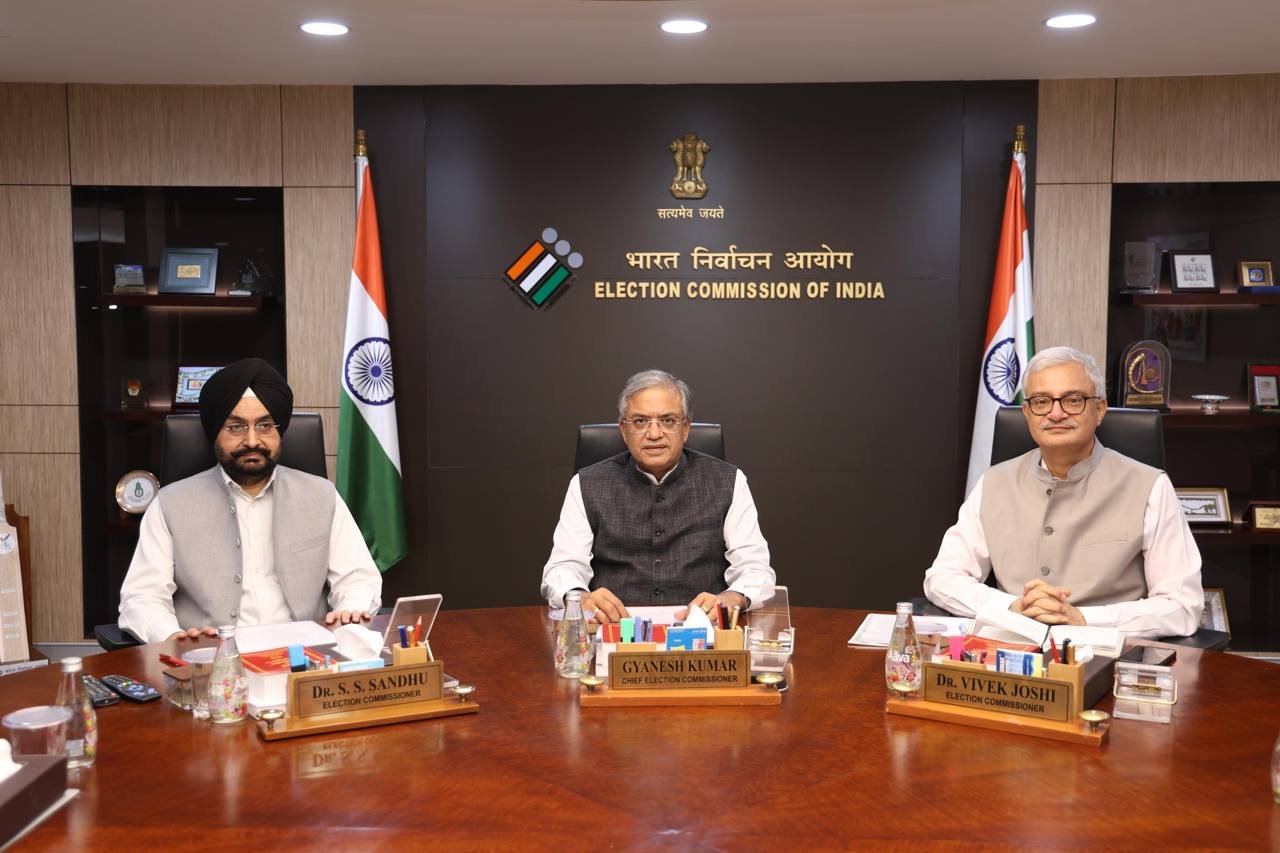
This is noteworthy because, in an earlier group photograph that I had seen, at least Gyanesh Kumar appeared to be smiling alongside Sukhbir Singh Sandhu and Vivek Joshi. As someone rightly pointed out, the issues between Gyanesh Kumar, Sukhbir Singh Sandhu, and Vivek Joshi may still not have been fully resolved, despite the press releases and tweets from BJP alliance partners. So, I am not ready to accept, without further evidence, that all the differences among Gyanesh Kumar, Sukhbir Singh Sandhu, and Vivek Joshi have been resolved.
Interestingly, people across India came to know about these reported differences between Gyanesh Kumar, Sukhbir Singh Sandhu, and Vivek Joshi after The Indian Express published a report on its front page on September 23.
In its report on September 23, The Indian Express said that Election Commissioners Sukhbir Singh Sandhu and Vivek Joshi repeatedly raised concerns about decisions being taken without their knowledge, including issues relating to voter registration, electoral-roll deletions, appeals, and control of electoral-roll software.
However, it was unexpected; Election Commissioners Sukhbir Singh Sandhu and Vivek Joshi had formally objected, on record, at least 14 times over the previous 10 months—four times on a single day—to decisions taken and orders issued without their knowledge, according to the objections cited in the report.
And The Indian Express report helps me ask the biggest question on behalf of the people of India to the ECI: How did the ECI’s ECINET software result in the deletion of the names of people who are Indian citizens from the electoral rolls? If they are Indian citizens, the CEC must explain why and how their names were removed from the electoral rolls and on what basis they were considered ineligible.
There is also a need to examine who developed the ECINET software, which company or individuals were involved in providing it, who was involved in developing and maintaining it, and how many people have access to the ECI’s ECINET system.
In the meantime, Gyanesh Kumar, Sukhbir Singh Sandhu, and Vivek Joshi did not hold a joint press conference to answer questions on September 26. Instead, they relied on press releases and social media influencers and political executives, who started tweeting that all was well at the ECI.
In my view, avoiding a joint press conference may have been intended to avoid inevitable further questions and controversy. However, their decision to issue a press statement may have invited even more questions, as several paragraphs raise questions that require answers from Gyanesh Kumar, Sukhbir Singh Sandhu, and Vivek Joshi.
Well, ladies and gentlemen, the press releases and image of the Election Commission of India (ECI) with the Election Commissioners were both released at 5:00 p.m. on September 26, and the statement issued at 6:45 p.m. in the presence of ANI, PTI, IANS and Door Darshan mike IDs through the ECI’s communications head are not enough to answer all the questions I have—and, I believe, the questions that more than 150 crore citizens of India may have. And at the end of the story, I will mention what the ECI said in its press statement on September 26.
What Needs to Be Done to Keep the ECI Independent
To ensure greater transparency and protect the national interest, opposition political party lawmakers should demand a special session of Parliament to discuss the present situation at the ECI and the reported differences between Gyanesh Kumar, Sukhbir Singh Sandhu, and Vivek Joshi.
Opposition political party lawmakers should also discuss the accountability and transparency of the SIR process, including the deletion of voters’ names and the addition of voters to the electoral rolls, particularly in light of the fact that the 2025 SIR began before the 2025 Bihar Assembly elections and concluded in Bihar just days before polling began in the state. They should also discuss West Bengal and Assam, where SIR was conducted before the Assembly elections.
.
Opposition political party lawmakers should also initiate impeachment proceedings against former IAS officer and Chief Election Commissioner (CEC) Gyanesh Kumar, and he should be removed from the post of Chief Election Commissioner in the national interest, as I believe his actions pose a serious threat to Indian democracy.
To ensure greater transparency and protect the national interest, opposition political parties should also demand that the number of Election Commission members be increased from three to five. The members should be selected from diverse services and professional backgrounds, including the officers from the Indian Army, the Indian Air Force, the Indian Navy and former judges.
Under the present system, concerns have been raised that former IAS officers who have served closely with political executives and politicians are getting opportunities to become Election Commissioners and subsequently Chief Election Commissioner of India. The selection process should therefore be broadened to include people from diverse professional and institutional backgrounds, while ensuring independence, transparency, and impartiality.
And not only political parties, but voters should also demand that the Goa, Uttarakhand, Punjab, Manipur, Uttar Pradesh, Gujarat, and Himachal Pradesh Assembly elections in 2027, as well as the 2028 Assembly elections in other poll-bound states and the 2029 Lok Sabha elections, should be conducted under a new Chief Election Commissioner of India and with new Election Commissioners, rather than under the present leadership of Chief Election Commissioner (CEC) Gyanesh Kumar and Election Commissioners Sukhbir Singh Sandhu and Vivek Joshi.
Is Gyanesh Kumar Misusing Section 16?
According to the report, the Election Commission is a constitutional body under Article 324, comprising the Chief Election Commissioner and two Election Commissioners who are equal in rank. The CEC is described as “first among equals” and does not have the power to decide matters alone. Under Section 18 of the Chief Election Commissioner and Other Election Commissioners (Appointment, Conditions of Service and Term of Office) Act, 2023, the business of the Commission is to be transacted as far as possible unanimously. Where the CEC and the Election Commissioners differ in opinion, the matter is decided according to the majority view.
The Indian Express has reported that Election Commissioners Sukhbir Singh Sandhu and Vivek Joshi repeatedly raised concerns about decisions being taken without their knowledge, including issues relating to voter registration, electoral-roll deletions, appeals, and control of electoral-roll software.
Since Chief Election Commissioner Gyanesh Kumar has allegedly ignored 14 objections raised by the two Election Commissioners over the past 10 months, it seems that Chief Election Commissioner of India Gyanesh Kumar may be taking advantage of Section 16 of the Chief Election Commissioner and Other Election Commissioners Act, 2023, which bars courts from entertaining or continuing civil or criminal proceedings against current or former Chief Election Commissioners (CECs) and Election Commissioners (ECs) for official acts or words spoken in the line of duty.
Credibility is everything
As a political journalist and the founder and editor of the National Political Mirror, the world’s only weekly political and independent #media house, I do not belong to any group affiliated with any political party or politician. I cover both the BJP and the Congress, and I stand by my claims and take full responsibility for what I write. I am speaking for myself—not on behalf of journalists who cover press conferences held by the BJP or Congress.
Going forward, I do not have a PIB accreditation card, so I am unable to attend ECI press conferences. However, many journalists who do not have PIB cards are attending ECI press conferences. I know some of their names, but I will never disclose their identities.
Previously, I was able to attend ECI press conferences during the tenure of former Chief Election Commissioner Rajiv Kumar, as well as those held by the CECs who served before him.
However, I have not been able to attend ECI press conferences under the current CEC, Mr. Gyanesh Kumar. Only the ECI Chief, Gyanesh Kumar, and the concerned officials can answer the questions I have raised. I will present those questions in my editorial.
I would like to end my words for now by saying something about the current situation: “If you lose #money, you lose nothing; if you lose your health, you lose something; but if you lose your credibility, you lose everything.” I strongly believe in these words and follow them in my day-to-day life, no matter what.
ECI Meeting Press Release: The Following Decisions Were Taken at the Meeting
In case of any person to whom notice has been issued during the ongoing SIR, for being unmapped and logical discrepancies, BLOs will visit the homes of such persons for collection of documents and thereafter upload them on the ECINet, for decision by the ERO. Such persons need not be called for hearing to ERO/AERO office. Only in exceptional circumstances, as decided by the ERO, the hearing will be held preferably online. Any adult member of the family can be authorized by the elector to attend the hearing on their behalf, if required. Facilities for the online hearing to be strengthened.
DEOs (District Election Officers) will create adequate number of help desks/hold special camps for the people living in night shelters, labor, poor people, homeless etc. as per requirement.
The declaration attached to Form 6 for SIR has been upheld by the Hon’ble Supreme Court. For non-SIR period, the Forms applicable as per Rules (the Registration of Electors Rules 1960) will be used.
Field officers have role-based access to the ECINET system as per their statutory powers. A Committee headed by Sr. Deputy Election Commissioner (DEC) and including an independent expert from IIT/IIIT will review the ECINET to double-check that it complies with the provisions of the Acts and Rules and submit report to the Commission. Various upgradations of the portal have already been made based on the inputs from State CEOs in the past few months. In case, any further flexibility is required by the field officers, that will be made operational. Henceforth, all the new initiatives about IT modules and portals will be discussed in the Committee of Officers (COO) before approval by the Commission.
In view of the request received from CEO Delhi, the period for filing claims and objections has been extended by the Commission till 30th October, 2026. The period of disposal of notices and claims & objections has been extended till 30th November 2026. Also, as per the request received from CEO Maharashtra, the period for filing claims and objections in Maharashtra has been extended by the Commission till 12th October, 2026. The period of disposal of notices and claims & objections in Maharashtra has been extended till 10th November 2026.
For all Commission’s meeting, agenda will be circulated in advance and minutes will be issued.
APARs {Annual Performance Appraisal Reports} of all the officers will be completed within the stipulated time frame, i.e., 31st December every year.
Approval of the Commission will be taken for foreign trips of the officers.
All directions issued by the Commissioners to the officers of the Commission shall be meticulously complied with.
SIR has already been completed in 20 States/UTs including Bihar and West Bengal. Any person whose name has got left out during SIR or thereafter, and any person including young/ first-time voter, may apply to the concerned ERO, for inclusion of their names in the electoral rolls under the process of continuous updation. CEOs have been directed to facilitate the same. The CEOs, DEOs, EROs will immediately launch a special drive for enrolment of these electors.
It is further reiterated that
The letter to Cabinet Secretary was not related to any policy matter of the Commission or IT division but related to working of an officer on deputation to ECI. The work re-distribution orders issued by the concerned officer were not actually implemented after the orders of the two Commissioners and the oversight over the IT division by the DEC was never actually withdrawn.
In the recent months, the Commission has taken numerous decisions including SIR across the country. The order for the SIR issued on 24.6.2025 for all the States/UTs, starting with Bihar, followed by West Bengal and 30 other States/UTs was issued with the unanimous approval of the Commission. The same has been upheld by the Hon’ble Supreme Court of India vide its order dated 27.5.2026. The schedule for SIR for 12 States and UTs was issued on 27.10.2025 and those for 19 States/ UTs was issued on 14.05.2026 with the unanimous approval of the Commission. The final figure of number of electors will be known only after final publication in the remaining 12 states of Phase-III.
The CEO Goa has directed concerned BLOs to conduct house to house visits to left out voters to collect their forms. 81 voters out of 97 have already filled Form 6 for inclusion.
